From Newton to Quantum: How Our Students Modeled “Force” Across Three Levels
In a hands-on STEM project, students explored a powerful idea at the heart of physics and mathematics: the same physical quantity—force—can appear simple in one model and far more complex in another. This change does not occur because the physical point changes, but because the mathematical description of the system evolves.
A Big Idea: The Same Concept Can Wear Different “Math Outfits”
Throughout this term, students investigated how force is represented across different levels of scientific modeling. By comparing classical mechanics, differential equations, and quantum mechanics, they discovered that complexity in physics often reflects the amount of structure we choose to track—not an increase in difficulty for its own sake.
To support students and their families, we worked through a structured in-class explainer using a single, consistent physical example.
One Particle, Three Levels of Description
To keep the discussion coherent, students modeled one particle moving in one dimension. The physical situation remained the same throughout the project, but the mathematical language changed as we moved to more advanced models.
1. Newtonian Level: Force as a Value at a Point

At the most familiar level, a particle has a well-defined position x(t), and force is treated as a simple quantity. We often describe force as a field evaluated at a point:
F(x, t)
Newton’s Second Law provides a direct relationship between force and motion:
F = ma = m · d²x / dt²
At a specific position x₀ and time t₀, it makes sense to speak of “the force at that point.” At this level, force is simply a number that can be calculated directly.
2. Differential Equation Level: Force as the Driver of Motion

When motion is described over time, force naturally appears inside a differential equation:
m · d²x / dt² = F(x, t)
If the force originates from a potential energy function V(x), then the same force becomes:
F(x) = − dV / dx
and the equation of motion is written as:
m · d²x / dt² = − dV / dx
For example, in the case of a spring:
- Force law: F(x) = −k x
- Differential equation: m x” + kx = 0
Here, force appears more complex because it governs how the system evolves in time, not merely its value at a single point.
3. Quantum Level: Force as an Operator
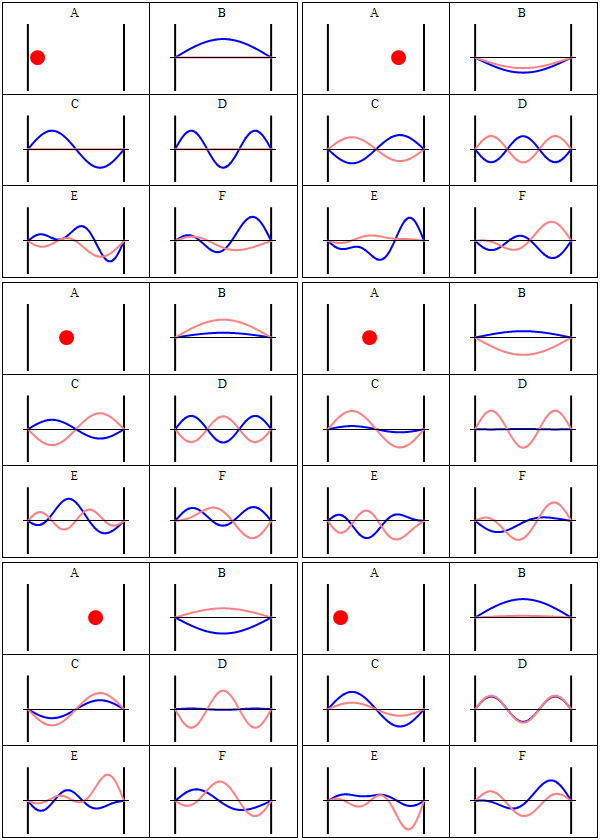
In quantum mechanics, the state of a particle is no longer described by a single position x(t). Instead, it is represented by a wavefunction ψ(x, t), which encodes probabilities.
The system evolves according to the Schrödinger equation:
iℏ · ∂ψ/∂t = ( −ℏ² / 2m · ∂²/∂x² + V(x) ) ψ
If the potential is V(x), force becomes an operator:
F̂ = − dV( x̂ ) / dx
Rather than measuring force at an exact point, quantum mechanics predicts expectation values, such as:
⟨F⟩ = ∫ ψ*(x,t) ( − dV/dx ) ψ(x,t) dx
Ehrenfest’s theorem connects this result back to classical motion:
m · d²⟨x⟩ / dt² = ⟨F⟩ = − ⟨ dV / dx ⟩
Same Physics, Different Meaning
Across all three levels, the same physical law persists, but its interpretation changes. Force evolves from a numerical value, to a term driving dynamics, to an operator whose effects are predicted statistically.
A Consistent Modeling Backbone
The three models were anchored to the same physical quantity: the potential energy. This established a unified framework connecting classical and quantum descriptions.
- Define V(x)
- Classical force: F = −∇V
- Classical dynamics: m x” = −∇V
- Quantum dynamics: Schrödinger equation with V(x)
- Quantum force: F̂ = −∇V( x̂ ), compared via ⟨F⟩